

The SwiftUI Way: patterns and anti-patterns for production apps
I'm very happy to announce the release of my new book: The SwiftUI Way. I wrote this guide for developers who are already working with the framework and are looking for deeper guidance on making technical trade-offs.
SwiftUI is very approachable for building functional interfaces quickly, but as projects grow in complexity, the initial simplicity can give way to certain challenges. It's not always obvious when design and architectural choices are merely a matter of style or fundamental errors that will eventually compromise application stability and runtime performance.
In an era where AI-assisted coding is becoming the norm, the ability to discern the right patterns from hard-to-spot anti-patterns has never been more critical. The goal of this book is to help you build an intuition for working with the framework rather than against it.
"The SwiftUI Way" covers key areas such as building maintainable view structures, managing data dependencies efficiently, optimizing view updates, handling state and data flow, creating performant lists and animations, and designing interfaces that respect platform conventions and accessibility. Rather than focusing on basic syntax, the book helps you recognize subtle anti-patterns, understand important trade-offs, and develop a deeper intuition for working naturally with the framework instead of against it.
These insights stem from my experience using SwiftUI in production since its initial release and my time working on the core SwiftUI team at Apple. Having been involved in the internal mechanics of the framework, I have seen firsthand how decisions about APIs are made and how the system is fundamentally designed to be used.
If you have gone beyond basic tutorials but often feel like you are fighting SwiftUI, dealing with unexpected view updates, unstable behavior, or uncertainty about the right way to structure features, this book is for you.
You can find more details and get your copy on the The SwiftUI Way book page.
I hope this book helps you build a clearer intuition for how the framework is designed to work, so you can spend less time fighting the system and more time focusing on your features.
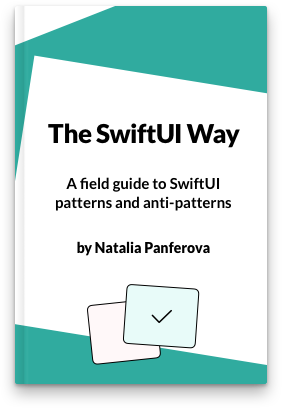
Work with SwiftUI. Not against it.$35
A field guide to SwiftUI patterns and anti-patterns
The SwiftUI Way
- Avoid common SwiftUI pitfalls
- Build deeper intuition for the framework
- Gain insights from a former SwiftUI Engineer at Apple
Work with SwiftUI. Not against it.
A field guide to SwiftUI patterns and anti-patterns
The SwiftUI Way